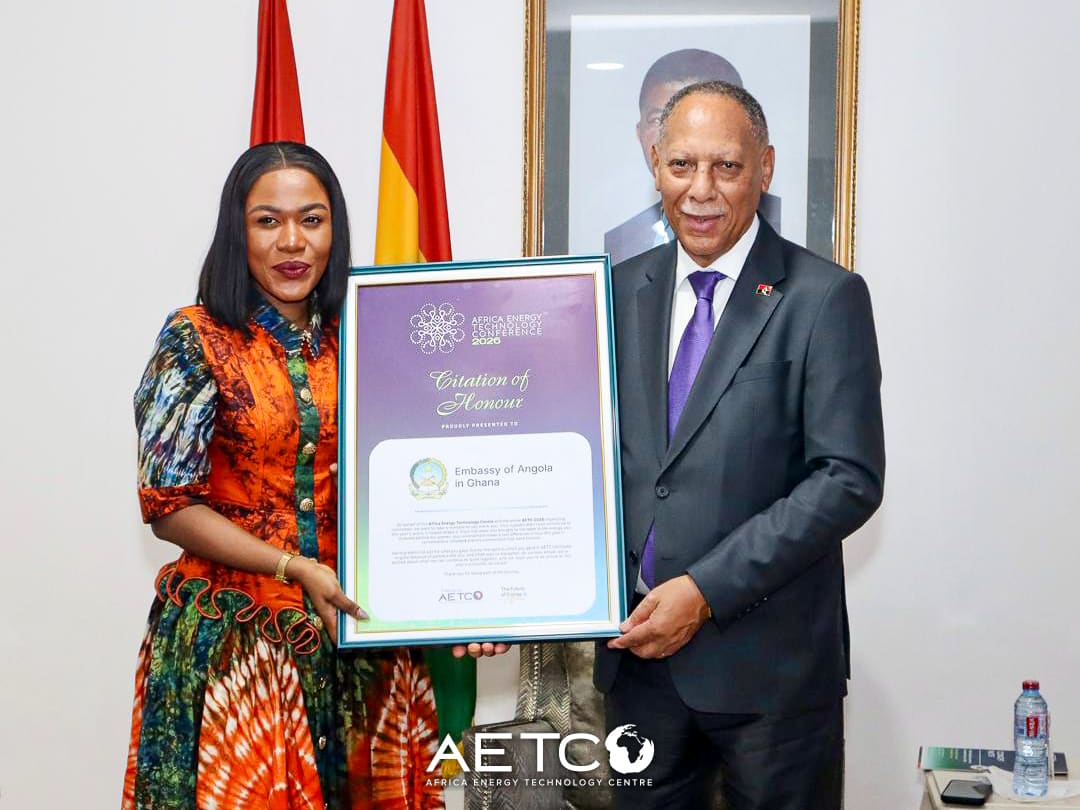



ACCRA, Ghana – The Africa Energy Technology Centre (AETC) has deepened its strategic engagement with the U.S. Embassy in Accra, building on earlier discussions on energy, technology, investment, innovation and sustainable development, and moving the dialogue towards practical areas of collaboration.
The meeting brought together Ms. Emelia Akumah, Founder & President of AETC, and Mr. Rolf Olson, Chargé d'Affaires of the U.S. Embassy in Accra, alongside Mr. Andrew G. Winkelman, Economic Counselor, and Ms. Justine King, Regional Deputy Director for Environment, Science, Technology and Health (ESTH). Ms. Akumah was accompanied by Ms. Ekua Appiah-Menka, Team Lead, AETC.

Ms. Akumah outlined the Centre's growing role in strengthening Africa's energy technology ecosystem and its mission to help the continent move from being primarily a consumer of imported technologies to becoming a producer, developer and exporter of indigenous solutions. She also highlighted AETC's expanding partnerships with governments, international institutions, private-sector stakeholders and technology partners across Africa and beyond.
Discussions reflected on the momentum of the 2026 Africa Energy Technology Conference, which convened more than 2,000 participants from Africa, Europe, the Middle East and Asia, including senior government officials and international delegations. That momentum now carries into the 2027 Africa Energy Technology Conference, taking place in Accra from 18–20 May 2027, under the theme "Engineering Sovereignty: Scaling and Commercializing Indigenous Technologies for Africa's Unified Energy Economy."
The 2027 edition will offer a key platform for advancing conversations on indigenous technology, commercialisation, investment, financing and international partnerships, including meaningful opportunities for U.S. companies and institutions to engage directly with African decision-makers, innovators, businesses and project developers.
A central theme of the meeting was the need to move beyond high-level dialogue towards practical collaboration and measurable results. Both parties recognised that successful partnerships must create value for all stakeholders, expanding Africa's access to appropriate technologies, investment, technical expertise and financing, while opening opportunities for U.S. companies and institutions within Africa's fast-growing energy and technology sector.